Introduction: Connectivity as Fleet Infrastructure
For modern fleet operations, connectivity is no longer an accessory—it is infrastructure.
Whether managing public transportation, logistics fleets, or municipal service vehicles, operators require a networking architecture that can support continuous mobility, real-time data flow, and centralized control.
The Core Requirements of Vehicle Networking
A scalable vehicle networking architecture must address four critical requirements:
-
Reliable mobile connectivity across changing network conditions
-
Secure data transmission for operational and video traffic
-
Centralized visibility and management across the entire fleet
-
Industrial-grade stability for harsh on-road environments
Meeting these requirements demands more than individual devices—it requires a unified architecture.
Architecture Overview: From Vehicle Edge to Central Control
A modern vehicle networking architecture typically consists of three layers:
-
Vehicle Edge Layer:Onboard gateways connect cameras, sensors, displays, and control units, aggregating data locally and ensuring stable uplink communication even during movement.
-
Network Transmission Layer:Cellular networks—especially 5G—provide the bandwidth and low latency needed for real-time data transmission, while redundancy mechanisms maintain continuity across regions.
-
Centralized Management Layer:A centralized platform enables fleet-wide monitoring, configuration, diagnostics, and lifecycle management, reducing operational complexity and manual intervention.
Why 5G Matters for Vehicle Networks
Compared with legacy cellular technologies, 5G enables:
-
Higher uplink bandwidth for HD video and diagnostics
-
Lower latency for time-sensitive applications
-
Greater network capacity for large-scale fleet deployments
These capabilities make 5G a key enabler for advanced vehicle networking architectures.
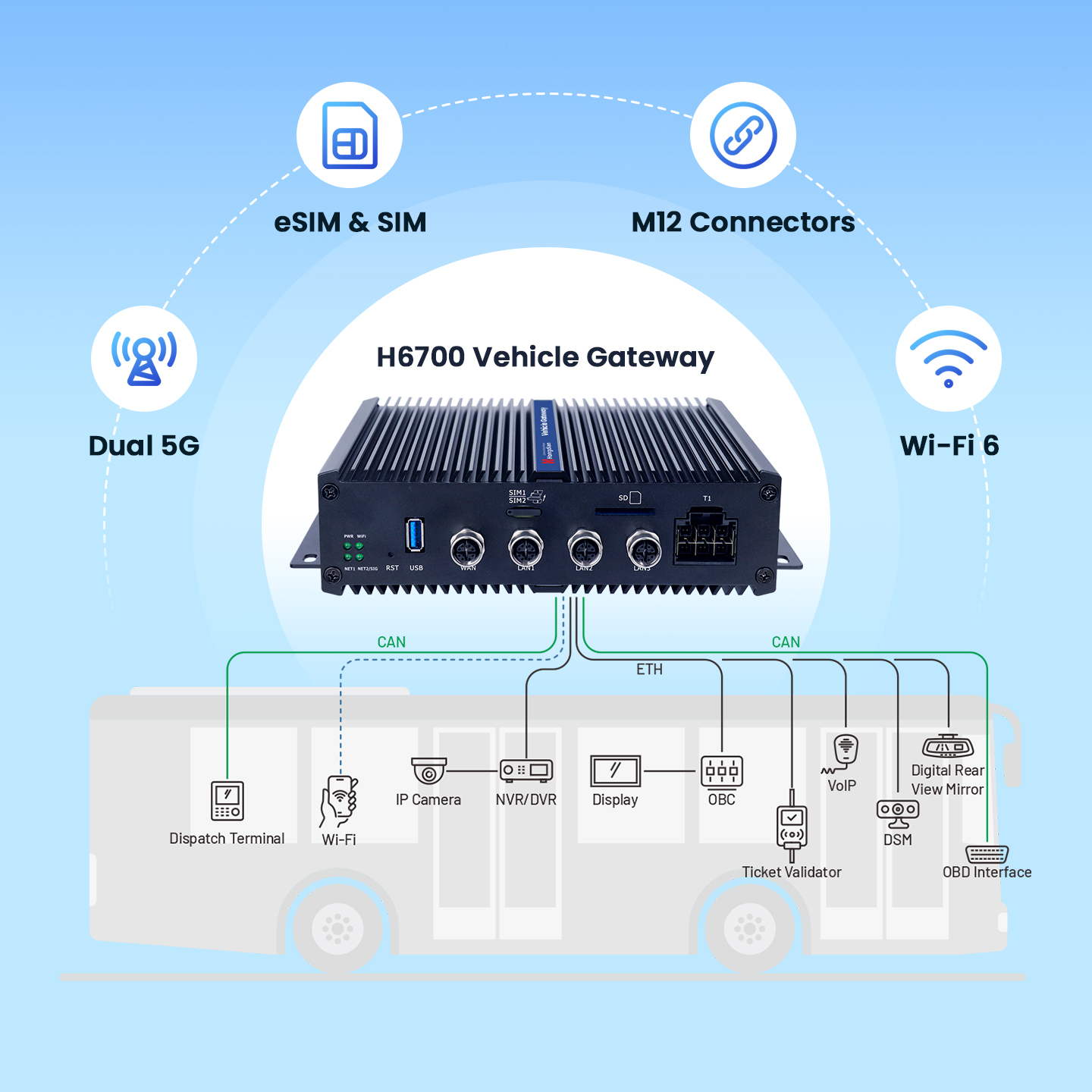
Recommended Product: H6700 5G Vehicle Gateway
To support this architecture, Hongdian offers the H6700 5G Vehicle Gateway, designed specifically for mobile and vehicular environments.
Key highlights include:
-
Industrial-grade design for vehicle deployment
-
Multi-interface support for onboard systems
-
High-performance 5G connectivity
-
Seamless integration into centralized fleet management platforms
Learn more about H6700
Enabling Smarter, Safer Fleet Operations
By adopting an architecture-driven approach to vehicle networking, fleets can move beyond fragmented connectivity and build a foundation for scalable, data-driven mobility operations.